



Research is at its best when inquisitive and dedicated scientists find innovative ways of using technology to push our scientific understanding ever further. Measuring the current is easy in shallow reefs, tidal estuaries, and rivers, but how about under a meter of sea ice in the Arctic? Dr. Andreas Muenchow had just this task, and turned to Lowell Instruments’ Tilt Current Meters for his unorthodox and effective solution.
The research was ambitious: the National Science Foundation award funding the project specified that Muenchow should, “design and develop an integrated underwater acoustic sensor network for ice-covered seas.” Muenchow identified land-fast sea ice (ice attached to the land, not free-floating) off Greenland as the perfect location for initial testing. Such a network could have far-reaching consequences in terms of scientific research on Arctic phenomena. First though, a project such as this required extensive research on the acoustic profile and other characteristics of the water just below the land-fast ice, including data on ocean currents.
Acoustic doppler profilers, the most common instrument for measuring currents underwater, are accurate and can often measure broad swathes of a water column. However, braving Arctic conditions, lugging several profilers on a sled, trying to get them through almost a meter of ice in sub-freezing temperatures, and finally, making sure they were close to level and stably fixed to the submerged underside of an ice sheet, would be far too difficult for a project of this scale. Besides, these methods of current measurement are often energy-intensive and expensive. The loss of even one such instrument under the fickle conditions of the Arctic would deal a serious financial blow to any project. Lowell Instruments’ Tilt Current Meters have none of these complications. Thin, lightweight, affordable, and with long battery life, they proved the perfect tool for the task. Rather than being anchored or otherwise secured to the bottom of a body of water – as they might be in coral reefs, ocean floors, or tidal systems – Muenchow chose to use an inversion kit supplied by Lowell Instruments to hang the meter downwards from the bottom of the ice rather than having it float upwards.
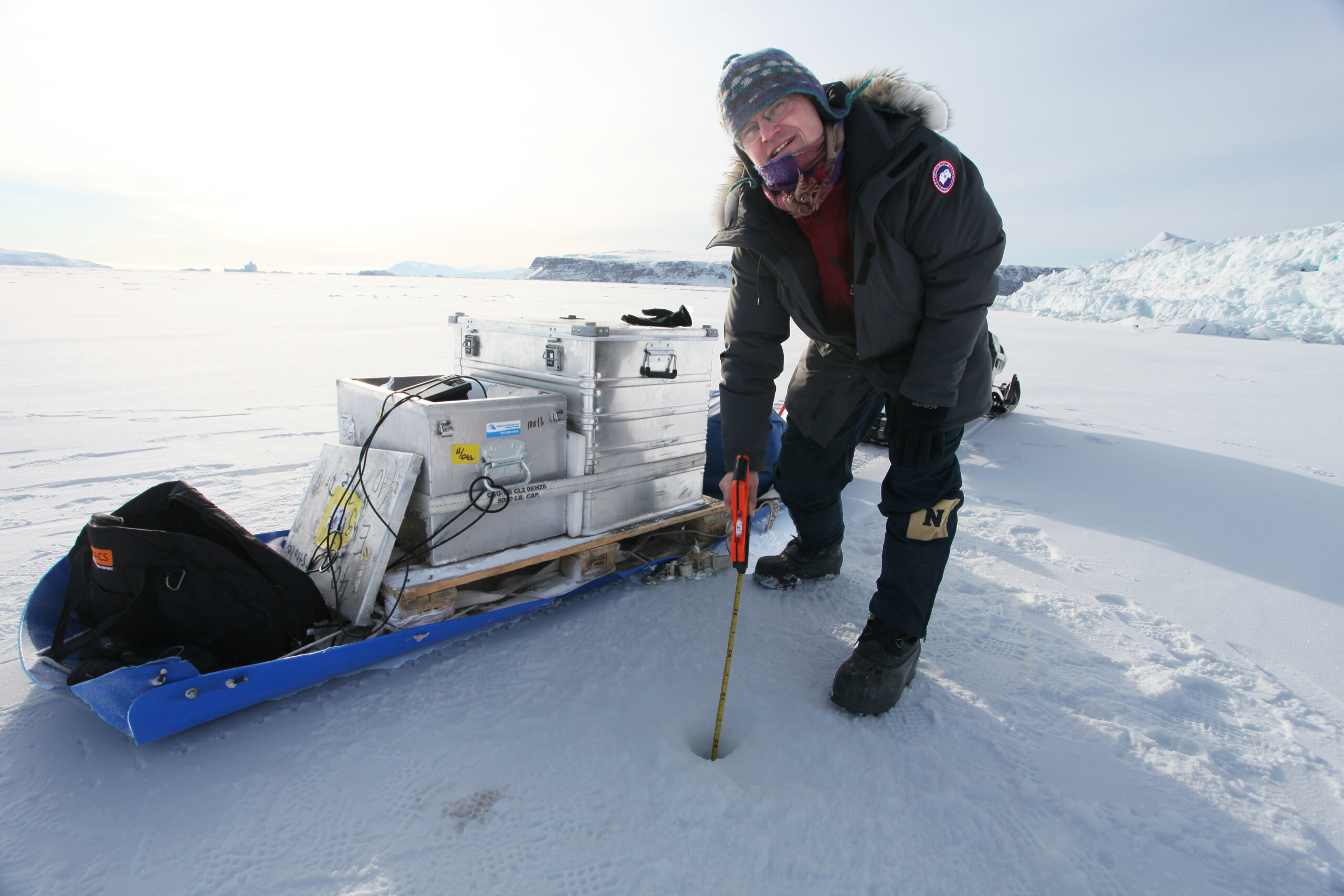
After initial scouting to determine the best possible locations to place instruments, Muenchow and his team set out onto the ice sheet with a research sled, on alert in case of rare polar bear aggression. At three locations, after drilling holes for their other instruments, the team unwrapped the batteries they had protected from the cold, their DeWalt hand drill, and their two-inch drill bit. They then drilled holes for the tilt meters, trying to minimize the time the tools spent out in the cold, conserving battery life. Impressively, each battery had enough charge for ten holes through the sometimes more than meter-thick ice.
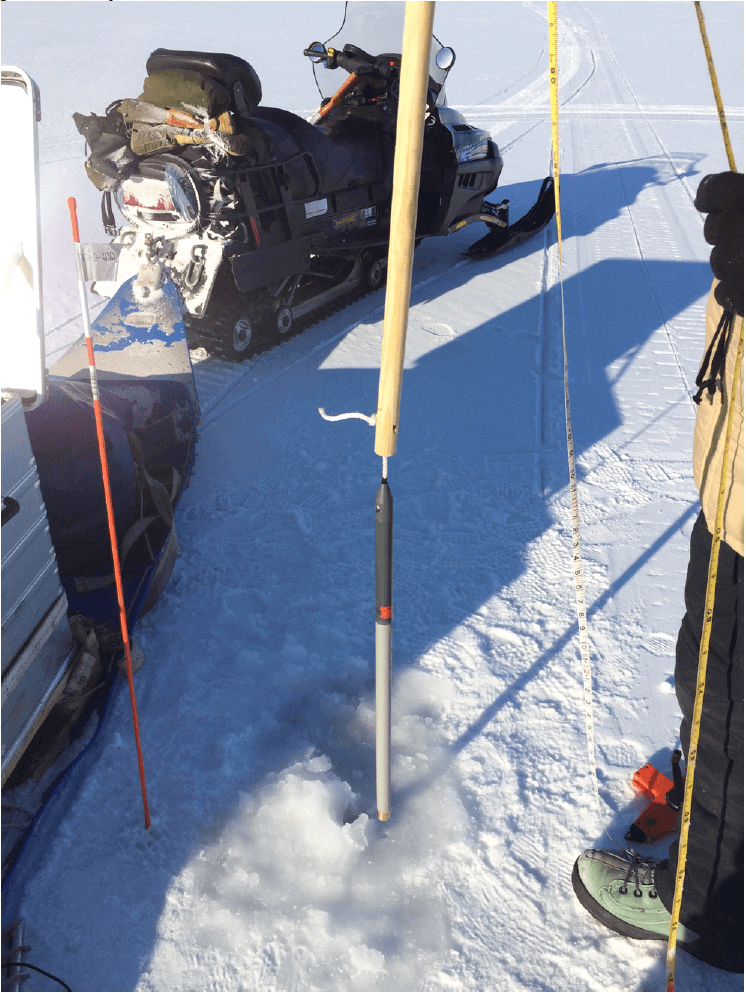
The meters were lowered through the drilled holes and attached to a wooden pole extending just below the underside of the sea ice. “Ocean currents were estimated from the drag on a [Lowell Instruments Tilt Current Meter] attached to the sea ice that measured accelerations and magnetic field strength vectors in all three spatial dimensions,” Muenchow noted, adding, “It is a promising new and simple technology that we successfully put to the test.”
For this project, Muenchow had preprogrammed the meters to collect data for several seconds every minute in a high frequency burst, a technique which can allow the meter to collect accurate data for months or even years. The instrument hung underneath the ice sheet from the wooden poles, about half a meter under the surface of the ice. Advanced accelerometers, magnetometers, and temperature sensors converted and corrected the tilt direction and degree into minute-by-minute data on current velocity and water temperature. After approximately three weeks of collecting data, Muenchow’s team pulled up the frozen poles, retrieved the tilt meters, and offloaded the data back at their camp.
Though others have used Lowell Instruments’ Tilt Current Meters in a similar inverted fashion, typically on the underside of docks or aquaculture floats, this is their first such use under an ice sheet. Muenchow’s use of the meters proved conclusively that not only can they function in such cold conditions, but also that their magnetometers are highly accurate even so close to the magnetic north pole. This promising technique could be used by other projects whenever temperature and current data are needed under hard-to-access surfaces, such as ice sheets in the Arctic or other submerged structures.
As climate change impacts ice sheets and the entire Arctic at an increasing rate, it is critical to gather as much scientific data as efficiently and as accurately as possible so that we fully understand the ways in which the earth is changing. The Arctic is one of the fastest changing parts of our world, and we believe that this innovative use of Lowell Instruments’ current meters should be in any arctic researcher’s toolbox as a rugged, reliable, and effective data collection solution.
For further analysis please see Andreas Muenchow. 2019. Currents under land fast sea ice from tilt sensor moorings in Wolstenholme Fjord, Greenland, March – April 2017. Arctic Data Center.
Products Used

TCM-1
The TCM-1 Tilt Current Meter is ideal for measuring water velocity from inland to the edge of the continental shelf.

Deployment Tip - Inverting the TCM
This application note describes how to deploy a TCM underneath a surface in an inverted fashion.